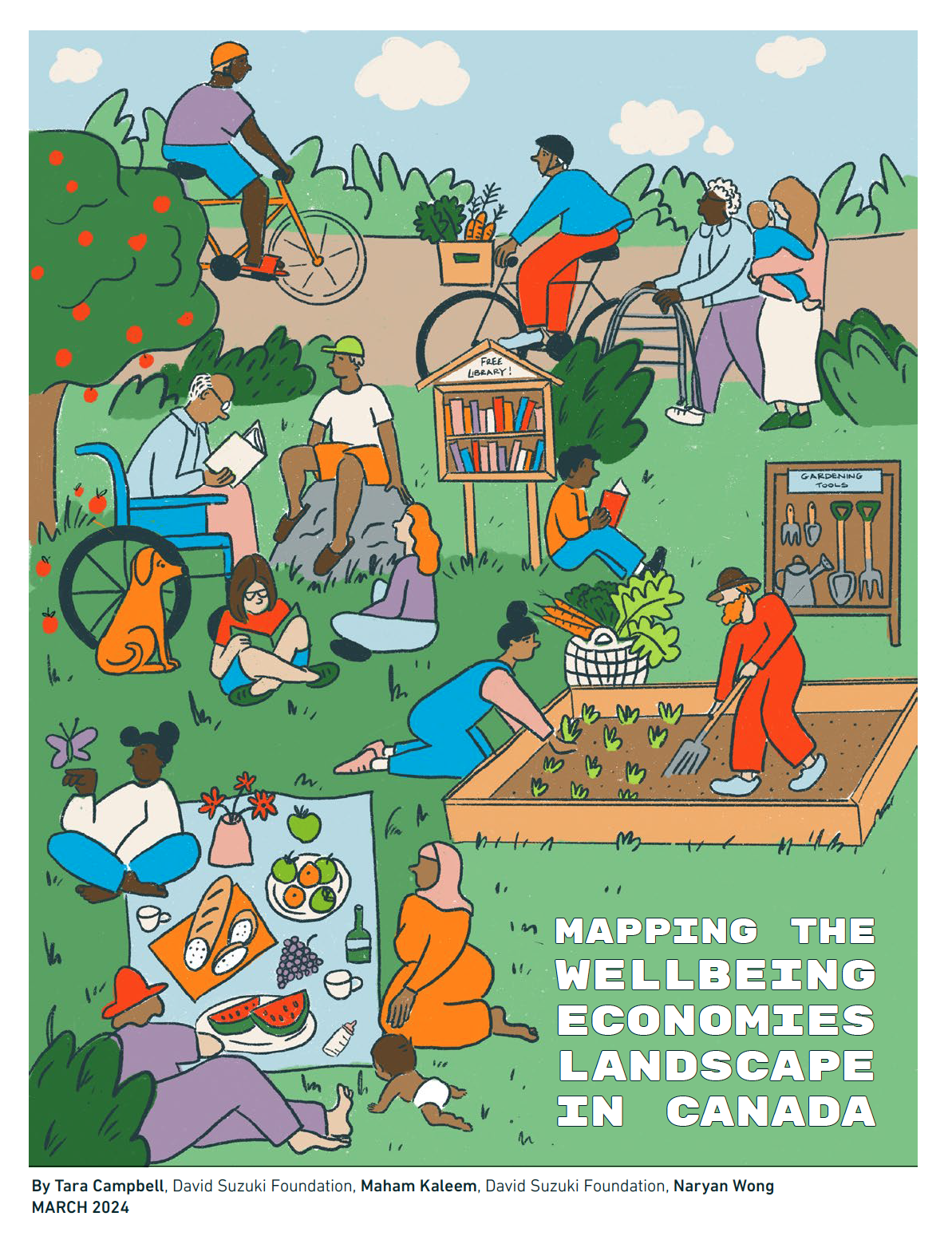
This report presents a landscape analysis of people, projects and organizations throughout Canada that are working to create wellbeing economies.
Wellbeing economies are an alternative to our current economic reality and are centred on a different purpose: to enable the flourishing of all life. There is no recipe for a wellbeing economy. However, there are a few principles they might have in common:
- Dignity: Everyone has enough to live in comfort, safety and happiness.
- Nature: A restored and safe natural world for all life.
- Purpose: Institutions serve the common good and create real value.
- Fairness: Justice is at the heart of the economy.
- Participation: Citizens are actively involved in their communities and locally rooted economies.
The Wellbeing Economies program at the David Suzuki Foundation is looking to catalyze an alliance of organizations, projects and people to support a transition in the Canadian economy toward a wellbeing economy. We are affiliated with the Wellbeing Economy Alliance (WEAll), a global collaboration working for economic systems change.
As we transition from a phase of unstructured network learning into this next intentional chapter, we felt the need to begin with a landscape map and some initial analyses.